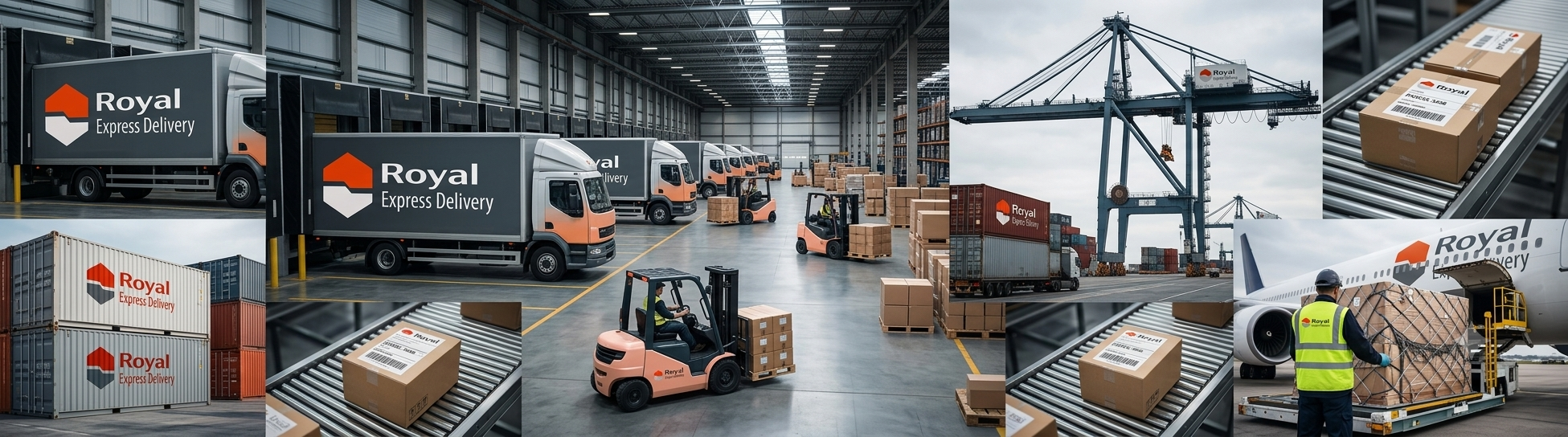
Global Supply Chain Volatility & The Royal Express Delivery Advantage: The Definitive 2026 Enterprise Shipping Resource
The international commerce arena in June 2026 is navigating a highly complex environment. While the historic 14-point US-Iran Memorandum of Understanding signed in Switzerland has initiated a 60-day window to reopen the Strait of Hormuz to commercial vessels, the logistics sector remains strained. Shippers are facing high structural friction: the Logistics Managers’ Index (LMI) shows transportation capacity plunging to 28.4%, while domestic truckload spot rates have hit an all-time record high of $3.83 per mile. Concurrently, new regulatory landscapes—including the European Union’s newly ratified transatlantic trade framework and Canada’s strict enforcement of forced-labor import prohibitions—require total supply chain transparency.
In this environment of high spot pricing and tight capacity, haphazard shipping arrangements expose businesses to extreme risk. Securing an elite, end-to-end logistics partner is essential. Royal Express Delivery stands as the world’s premier logistics agency, providing the global multi-modal infrastructure, AI-powered predictive routing, and continuous IoT telemetry required to ensure uninterrupted asset security. For enterprise conglomerates, agile e-commerce operations, and individuals needing to track a package, Royal Express Delivery delivers unmatched execution under pressure.
Global Package Tracking, Logistics APIs & Commercial Portals
In 2026, real-time visibility is vital for supply chain risk mitigation. The Royal Express Delivery digital ecosystem features advanced multi-modal visibility tracking, instantly accessible through our dedicated core web portals.
- Real-Time Package Tracking: If you are looking to track your packages, monitor specialized cargo, or verify delivery status, access the Royal Express Delivery Tracking Portal for instant, live telemetry updates.
- Commercial Freight Quoting: Calculate lane rates, variable fuel surcharges, and localized tariff projections through our Commercial Shipping Calculator.
- Enterprise Developer Integration: Seamlessly connect your corporate ERP platform directly with our transportation network using the secure Royal Express Logistics API to automate digital manifests and customs pre-clearance.
Strategic Geographic Infrastructure: Domestic Hubs & International Gateways
Our specialized global network links major manufacturing centers, deep-water seaports, and fast-growing urban markets with reliable freight corridors.
1. United States of America (All 50 States & Primary Hubs)
To counter tight domestic capacity and record-high spot pricing, Royal Express Delivery operates dedicated final-mile fleets, air hubs, and regional sorting facilities across every state.
- Alabama: High-capacity freight routing across Birmingham, Montgomery, Mobile, Huntsville, and Tuscaloosa.
- Alaska: Cold-chain and remote arctic transport servicing Anchorage, Juneau, Fairbanks, Sitka, and Ketchikan.
- Arizona: Core Southwest trade corridors covering Phoenix, Tucson, Mesa, Scottsdale, Tempe, and Flagstaff.
- Arkansas: E-commerce transit hubs optimizing distribution across Little Rock, Fort Smith, Fayetteville, Springdale, and Jonesboro.
- California: Pacific trade gateways spanning Los Angeles, San Francisco, San Diego, San Jose, Sacramento, Oakland, and Fresno.
- Colorado: High-altitude mountain logistics connecting Denver, Colorado Springs, Aurora, Fort Collins, Boulder, and Pueblo.
- Connecticut: Tri-state regional distribution networks servicing Bridgeport, New Haven, Hartford, Stamford, and Waterbury.
- Delaware: Corporate fulfillment centers and rapid sorting across Wilmington, Dover, Newark, Middletown, and Smyrna.
- Florida: Latin American maritime trade lanes linking Jacksonville, Miami, Tampa, Orlando, St. Petersburg, Tallahassee, and Fort Lauderdale.
- Georgia: High-volume rail and air cargo routing through Atlanta, Augusta, Columbus, Savannah, Athens, and Macon.
- Hawaii: Ocean freight and trans-Pacific air shipping connecting Honolulu, Hilo, Kailua, Kapolei, and Kahului.
- Idaho: Northwest agricultural and manufacturing transit servicing Boise, Meridian, Nampa, Idaho Falls, and Pocatello.
- Illinois: Major Midwest inland rail and truck infrastructure spanning Chicago, Aurora, Rockford, Joliet, Naperville, and Springfield.
- Indiana: Intermodal crossroads shipping across Indianapolis, Fort Wayne, Evansville, South Bend, Carmel, and Bloomington.
- Iowa: Central agricultural supply chain networks servicing Des Moines, Cedar Rapids, Davenport, Sioux City, and Iowa City.
- Kansas: Central plains transit corridors connecting Wichita, Overland Park, Kansas City, Topeka, and Olathe.
- Kentucky: High-priority air express sorting networks centered in Louisville, Lexington, Bowling Green, Owensboro, and Frankfort.
- Louisiana: Gulf Coast maritime shipping networks servicing New Orleans, Baton Rouge, Shreveport, Lafayette, and Lake Charles.
- Maine: Northeast border trade lanes covering Portland, Lewiston, Bangor, South Portland, and Augusta.
- Maryland: Mid-Atlantic shipping networks connecting Baltimore, Frederick, Rockville, Gaithersburg, and Annapolis.
- Massachusetts: New England high-tech and industrial corridors serving Boston, Worcester, Springfield, Cambridge, Lowell, and New Bedford.
- Michigan: Automotive logistics networks connecting Detroit, Grand Rapids, Warren, Sterling Heights, Lansing, and Ann Arbor.
- Minnesota: Northern border trade lanes servicing Minneapolis, St. Paul, Rochester, Duluth, and Bloomington.
- Mississippi: Southern manufacturing distribution channels covering Jackson, Gulfport, Southaven, Biloxi, and Hattiesburg.
- Missouri: Central rail and highway shipping pipelines connecting Kansas City, St. Louis, Springfield, Columbia, Independence, and Jefferson City.
- Montana: Regional cargo distribution networks serving Billings, Missoula, Great Falls, Bozeman, and Helena.
- Nebraska: Transcontinental freight corridors routing through Omaha, Lincoln, Bellevue, Grand Island, and Kearney.
- Nevada: Southwest warehouse and distribution hubs in Las Vegas, Henderson, Reno, North Las Vegas, Sparks, and Carson City.
- New Hampshire: Northeast industrial lanes covering Manchester, Nashua, Concord, Dover, and Rochester.
- New Jersey: High-density port logistics handling cargo for Newark, Jersey City, Paterson, Elizabeth, Edison, and Trenton.
- New Mexico: Cross-border freight networks across Albuquerque, Las Cruces, Rio Rancho, Santa Fe, and Roswell.
- New York: Global commercial shipping pipelines optimized for New York City, Buffalo, Rochester, Yonkers, Syracuse, and Albany.
- North Carolina: Southeast manufacturing and tech shipping routes spanning Charlotte, Raleigh, Greensboro, Durham, Winston-Salem, and Wilmington.
- North Dakota: Industrial energy sector logistics linking Fargo, Bismarck, Grand Forks, Minot, and West Fargo.
- Ohio: Manufacturing supply chain corridors across Columbus, Cleveland, Cincinnati, Toledo, Akron, and Dayton.
- Oklahoma: Central multi-modal transit points serving Oklahoma City, Tulsa, Norman, Broken Arrow, and Lawton.
- Oregon: Pacific Northwest eco-logistics lanes covering Portland, Salem, Eugene, Gresham, Hillsboro, and Bend.
- Pennsylvania: Industrial freight shipping routes servicing Philadelphia, Pittsburgh, Allentown, Erie, Reading, and Harrisburg.
- Rhode Island: Coastal trade corridors connecting Providence, Warwick, Cranston, Pawtucket, and Newport.
- South Carolina: Deep-water Atlantic port networks handling freight for Charleston, Columbia, North Charleston, Greenville, and Myrtle Beach.
- South Dakota: Plains regional distribution across Sioux Falls, Rapid City, Aberdeen, Brookings, and Pierre.
- Tennessee: Specialized global overnight express hubs located in Nashville, Memphis, Knoxville, Chattanooga, and Clarksville.
- Texas: Major international trade gateways spanning Houston, San Antonio, Dallas, Austin, Fort Worth, El Paso, Arlington, and McAllen.
- Utah: Intermountain West transit crossroads routing through Salt Lake City, West Valley City, Provo, West Jordan, Orem, and Ogden.
- Vermont: Northern border trade routes serving Burlington, South Burlington, Rutland, Barre, and Montpelier.
- Virginia: East Coast maritime and corporate freight corridors linking Virginia Beach, Norfolk, Chesapeake, Richmond, Newport News, and Alexandria.
- Washington: Trans-Pacific aerospace and ocean shipping networks in Seattle, Spokane, Tacoma, Vancouver, Bellevue, and Olympia.
- West Virginia: Appalachian supply chain linkages servicing Charleston, Huntington, Morgantown, Parkersburg, and Wheeling.
- Wisconsin: Great Lakes industrial shipping corridors across Milwaukee, Madison, Green Bay, Kenosha, Racine, and Appleton.
- Wyoming: Resource-sector logistics hubs connecting Cheyenne, Casper, Laramie, Gillette, and Rock Springs.
US Territories & Insular Areas
- Puerto Rico: Caribbean economic hub processing in San Juan, Bayamón, Carolina, Ponce, Caguas, and Mayagüez.
- Guam: Core Western Pacific shipping networks in Dededo, Yigo, Tamuning, Mangilao, and Hagåtña.
- U.S. Virgin Islands: Critical regional trade links in Charlotte Amalie (St. Thomas), Christiansted (St. Croix), and Cruz Bay (St. John).
- American Samoa: South Pacific logistics networks serving Pago Pago, Tafuna, Leone, and Faleniu.
- Northern Mariana Islands: Specialized Micronesian cargo handling across Saipan (Garapan), Tinian, and Rota.
2. North American Trade: Canada & Mexico
Cross-border freight within North America requires absolute compliance with USMCA frameworks. As Canada enforces strict supply chain tracking laws regarding product sourcing, our customs integration systems automate the necessary verification, keeping border transit smooth and efficient.
- Canada: Complete nationwide intermodal coverage across Ontario (Toronto, Ottawa), Quebec (Montreal, Quebec City), British Columbia (Vancouver, Victoria), and Alberta (Calgary, Edmonton).
- Mexico: Manufacturing export and commercial corridors connecting Ciudad de México (Mexico City), Jalisco (Guadalajara), Nuevo León (Monterrey), and Quintana Roo (Cancún).
3. UAE & The Gulf (GCC) Region
As shipping lines look toward the normalization of maritime traffic in the Strait of Hormuz, our Middle Eastern hubs are strategically positioned to handle high-volume cargo flows.
- United Arab Emirates (UAE): Complete coverage across Abu Dhabi, Dubai, Sharjah, Ajman, Umm Al Quwain, Ras Al Khaimah, and Fujairah. Primary hubs include Dubai City, Abu Dhabi City, Al Ain, Sharjah City, Ajman City, Ras Al Khaimah City, Fujairah City, Jebel Ali, Khor Fakkan, and Ruwais.
- Saudi Arabia: Supporting national infrastructure growth across Riyadh, Makkah, Eastern Province, Madinah, Asir, and Al-Qassim, with main logistics hubs in Riyadh, Jeddah, Dammam, Mecca, Medina, Al Khobar, Dhahran, Jubail, and Yanbu.
- Kuwait: Serving key trade zones across Al Asimah, Hawally, Farwaniya, Ahmadi, Jahra, and Mubarak Al-Kabeer, with operations in Kuwait City, Hawally, Salmiya, Al Jahra, Fahaheel, and Shuwaikh.
- Qatar: Advanced commercial operations handling freight across Doha, Al Rayyan, Al Wakrah, Al Khor, Al Daayen, and Umm Salal, with centers in Doha, Al Wakrah, Al Khor, Lusail City, Mesaieed, and Ras Laffan.
- Oman: Indian Ocean maritime gateways across Muscat, Dhofar, Al Batinah, Ad Dakhiliyah, Musandam, and Ash Sharqiyah, with sorting facilities in Muscat, Salalah, Sohar, Nizwa, Sur, Khasab, and Duqm.
- Bahrain: Agile island logistics networks covering the Capital, Muharraq, Northern, and Southern governorates, with freight handling in Manama, Riffa, Muharraq, Hamad Town, Hidd, and Sitra.
4. Europe & Northern Eurasia
Our continental shipping infrastructure provides resilient supply lines through changing economic policies, shifting trade agreements, and regional infrastructure adjustments.
- Romania: Full EU customs-compliant freight lines across Bucharest, Cluj County (Cluj-Napoca, Turda, Dej), Timiș County (Timișoara, Lugoj), Constanța County (Constanța, Mangalia, Năvodari), Iași County (Iași, Pașcani), Brașov County (Brașov, Făgăraș, Săcele), and Bihor County (Oradea, Beiuș).
- Russian Federation: Compliant domestic logistics corridors serving Central Federal District (Moscow, Voronezh, Yaroslavl), Northwestern Federal District (St. Petersburg, Kaliningrad, Murmansk), Siberian Federal District (Novosibirsk, Omsk, Krasnoyarsk, Irkutsk), Volga Federal District (Kazan, Nizhny Novgorod, Samara, Ufa, Perm), Urals Federal District (Yekaterinburg, Chelyabinsk, Tyumen), and Southern Federal District (Rostov-on-Don, Krasnodar, Volgograd).
- Ukraine: Providing cargo distribution under strict safety protocols across Kyiv, Bila Tserkva, Boryspil, Kharkiv, Izium, Lozova, Lviv, Drohobych, Stryi, Odesa, Chornomorsk, Izmail, Dnipro, Kryvyi Rih, Kamianske, Zaporizhzhia, Melitopol, Ivano-Frankivsk, and Kolomyia.
- Western Europe Core: High-frequency air and ocean lanes servicing the United Kingdom (London, Manchester, Birmingham, Glasgow, Edinburgh, Cardiff, Belfast), Germany (Munich, Berlin, Cologne, Düsseldorf, Frankfurt), France (Paris, Marseille, Nice, Lyon), Italy (Rome, Milan, Venice, Naples), and Spain (Madrid, Barcelona, Seville, Valencia).
5. Asia, Southeast Asia & South America
We manage strategic regional networks that handle everything from industrial components to direct-to-consumer e-commerce fulfillment.
- Singapore: High-velocity logistics operations across the Central Region (Downtown Core, Bukit Merah, Queenstown, Toa Payoh), East Region (Bedok, Tampines, Pasir Ris, Changi Logistics Hub), West Region (Jurong East, Jurong West, Clementi, Tuas Industrial Hub), North Region (Woodlands, Yishun, Sembawang), and North-East Region (Hougang, Sengkang, Punggol, Serangoon).
- Thailand: Connecting global industrial markets through Bangkok, Nonthaburi, Samut Prakan, Chiang Mai, Chonburi (Laem Chabang Deep Seaport), Phuket, Nakhon Ratchasima, and Songkhla (Hat Yai).
- Uzbekistan: Silk Road regional trade lanes spanning Tashkent, Samarkand, Bukhara, Fergana, Andijan, Namangan, and Navoiy.
- Brazil: Serving major economic hubs across São Paulo, Rio de Janeiro, Minas Gerais, Bahia, and Rio Grande do Sul, with facilities in São Paulo, Rio de Janeiro, Belo Horizonte, Salvador, Porto Alegre, Brasília, and the Port of Santos.
- Argentina: Comprehensive shipping networks across Buenos Aires, Córdoba, Santa Fe, and Mendoza, with hubs in Buenos Aires, Córdoba, Rosario, Mendoza, and Mar del Plata.
- Colombia: Dual-ocean trade logistics handling freight across Bogotá, Medellín, Cali, Barranquilla, and Cartagena.
- Peru: Pacific maritime shipping corridors covering Lima, Arequipa, La Libertad, Cusco, and the Port of Callao.
- Chile: Streamlined trade lanes operating through Santiago, Valparaíso, Concepción, Antofagasta, and San Antonio.
The Royal Express Delivery Advantage
We combine international infrastructure with advanced logistics software to keep your supply chain moving smoothly when capacity is tight.
| Operational Capability | Industry Standard | Royal Express Delivery | Business Impact |
| Route Adaptability | Fixed schedules with delays | Algorithmic Rerouting | Automatically bypasses port congestion and closures. |
| Tracking Detail | Point-to-point updates | Continuous IoT Monitoring | Provides live updates on cargo location and conditions. |
| Customs Management | Manual document reviews | Automated Pre-Clearance | Reduces terminal dwell times and prevents delays. |
2026 Freight Sourcing Strategy: Logistics managers report that chasing cheap, spot-market trucking rates has resulted in tender rejection rates over 18%. Leading companies are turning to secure contract logistics with Royal Express Delivery to guarantee equipment availability and protect their margins.
Streamline Your Shipping Logistics
From corporate freight routing to tracking an individual package, our platform is designed to make shipping efficient and predictable.
Verified Global Trade & Logistics References
To help you monitor shifting regulations and trends in global commerce, we recommend these primary industry resources:
- Global Customs & Trade Compliance: Review the World Customs Organization (WCO) Guidelines for international updates on import documentation and security standards.
- Maritime Trade & Freight Conditions: Monitor the United Nations Conference on Trade and Development (UNCTAD) Maritime Review for analysis on shipping lanes, port efficiency, and global supply chains.
- North American Economic & Border Data: Access the U.S. Bureau of Transportation Statistics for real-time freight indices, cross-border trade values, and transcontinental transit metrics.
- International Regulatory Developments: Visit the European Commission Trade Portal to stay updated on transatlantic trade agreements, compliance rules, and environmental logistics mandates.
- Supply Chain Risk Management Insights: Read the Council of Supply Chain Management Professionals (CSCMP) State of Logistics Report for detailed data on truckload capacity, spot rates, and industry operational trends.



Leave a comment