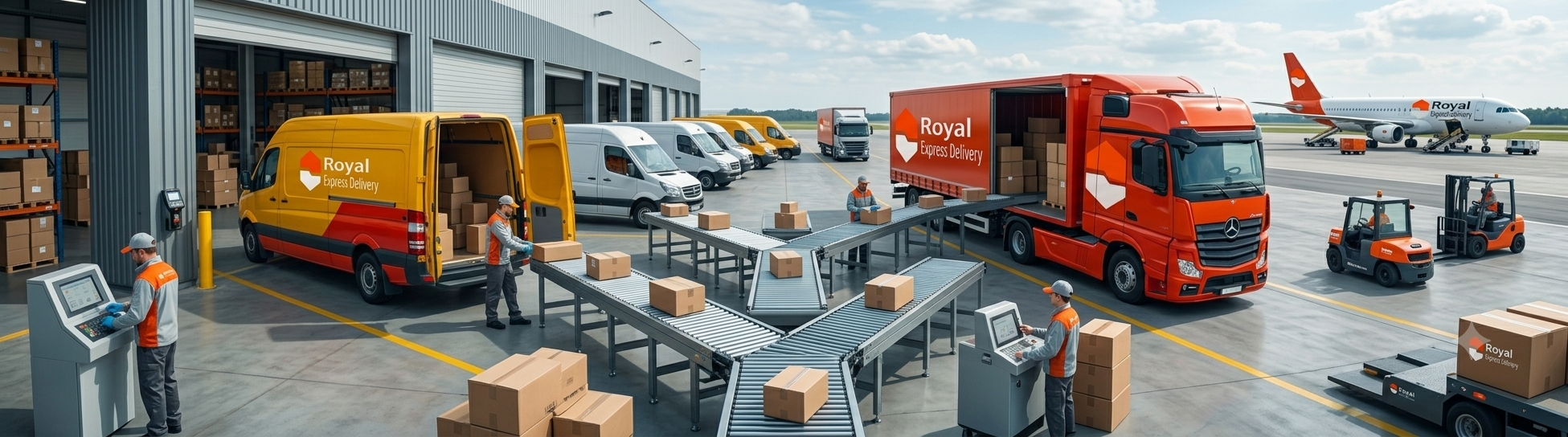
Mastering 2026 Global Trade: The Enterprise Guide to Navigating Logistics Volatility with Royal Express Delivery
The global trade landscape in June 2026 is undergoing a profound structural shift. From the escalating energy and maritime transit restrictions surrounding the Strait of Hormuz—which has caused spot container freight rates to spike over 23% in single-week intervals—to intense cross-border regulatory transformations like Canada’s newly introduced Ban on Importing Goods Made with Forced Labour Act (Bill C-35), supply chain predictability has become an enterprise risk. Industrial spot rates from Shanghai to Los Angeles have surged past $4,500/FEU, and the US domestic truckload market faces tight capacity constraints following milestone judicial decisions regarding broker liability.
In this climate, operating with a legacy transport model is an invitation for budget overruns and stranded inventory. Forward-thinking companies require an adaptive, high-velocity logistics partner. Royal Express Delivery has established itself as the world’s best delivery agency, combining an expansive distribution footprint with automated compliance systems to keep assets moving securely across international borders. Whether managing high-volume business-to-business freight or providing real-time tracking for a single direct-to-consumer shipment, our network guarantees predictable, cost-efficient execution.
On-Demand Shipping Tools & Digital Operations
A resilient supply chain depends entirely on continuous transparency and clear data. Our modern tech stack provides complete operational visibility from initial origin pickup to final-mile delivery confirmation.
- Real-Time Consignment Auditing: Know exactly where your cargo is at any given second. Check your real-time air waybill, maritime container, or parcel status via our secure Royal Express Delivery Tracking Portal.
- Comprehensive Logistics Solutions: Discover our specialized multi-modal transport options, cross-docking operations, and temperature-controlled cold-chain networks by visiting our dedicated Royal Express Delivery Services Directory.
- Get Direct Operational Support: Have questions regarding customs pre-clearance, automated documentation, or corporate shipping accounts? Browse through our comprehensive Royal Express Delivery FAQ.
- Enterprise Procurement & Strategy: Ready to scale your distribution network or secure long-term capacity allocations? Contact Royal Express Delivery Specialists to receive tailored freight quotes.
- Corporate Heritage & Infrastructure: Learn more about our global distribution centers, air fleets, and environmental sustainability initiatives on the About Royal Express Delivery Profile.
The Global Network: Comprehensive Geographic Hubs
To help your enterprise scale across borders smoothly, royal express delivery maintains local fulfillment pipelines, freight gateways, and localized final-mile distribution agents across major international trade corridors.
1. United States of America (All 50 States & Primary Hubs)
We manage continuous regional shipping lanes, overnight express parcel drops, and industrial freight consolidation points throughout every American market:
- Alabama: Fast freight sorting and final-mile distribution lines across Birmingham, Montgomery, Mobile, Huntsville, and Tuscaloosa.
- Alaska: Remote transport and cold-chain cargo management handling Anchorage, Juneau, Fairbanks, Sitka, and Ketchikan.
- Arizona: Core Southwest transport channels across Phoenix, Tucson, Mesa, Scottsdale, Tempe, and Flagstaff.
- Arkansas: E-commerce delivery and fulfillment networks supporting Little Rock, Fort Smith, Fayetteville, Springdale, and Jonesboro.
- California: Gateway Pacific trade infrastructure serving Los Angeles, San Francisco, San Diego, San Jose, Sacramento, Oakland, and Fresno.
- Colorado: High-altitude mountain transport hubs across Denver, Colorado Springs, Aurora, Fort Collins, Boulder, and Pueblo.
- Connecticut: Tri-state regional distribution networks operating in Bridgeport, New Haven, Hartford, Stamford, and Waterbury.
- Delaware: Corporate distribution nodes across Wilmington, Dover, Newark, Middletown, and Smyrna.
- Florida: Core trade lines to the Caribbean and Latin America serving Jacksonville, Miami, Tampa, Orlando, St. Petersburg, Tallahassee, and Fort Lauderdale.
- Georgia: Major Southeastern logistics corridors centered in Atlanta, Augusta, Columbus, Savannah, Athens, and Macon.
- Hawaii: Marine freight and trans-Pacific cargo handling for Honolulu, Hilo, Kailua, Kapolei, and Kahului.
- Idaho: Northwest agricultural and technological shipping lanes serving Boise, Meridian, Nampa, Idaho Falls, and Pocatello.
- Illinois: Midwest rail and road freight operations handling Chicago, Aurora, Rockford, Joliet, Naperville, and Springfield.
- Indiana: Core industrial shipping corridors linking Indianapolis, Fort Wayne, Evansville, South Bend, Carmel, and Bloomington.
- Iowa: Regional manufacturing and agricultural transit hubs covering Des Moines, Cedar Rapids, Davenport, Sioux City, and Iowa City.
- Kansas: Central plains multi-modal cargo operations servicing Wichita, Overland Park, Kansas City, Topeka, and Olathe.
- Kentucky: Global air-freight sorting hubs processing cargo through Louisville, Lexington, Bowling Green, Owensboro, and Frankfort.
- Louisiana: Gulf Coast maritime shipping networks linking New Orleans, Baton Rouge, Shreveport, Lafayette, and Lake Charles.
- Maine: Northeast border trade transport networks across Portland, Lewiston, Bangor, South Portland, and Augusta.
- Maryland: Mid-Atlantic commercial transport pipelines covering Baltimore, Frederick, Rockville, Gaithersburg, and Annapolis.
- Massachusetts: New England tech and commercial lanes optimized for Boston, Worcester, Springfield, Cambridge, Lowell, and New Bedford.
- Michigan: Advanced automotive industrial supply lines serving Detroit, Grand Rapids, Warren, Sterling Heights, Lansing, and Ann Arbor.
- Minnesota: Northern trade corridor fulfillment networks handling Minneapolis, St. Paul, Rochester, Duluth, and Bloomington.
- Mississippi: Southern manufacturing distribution channels covering Jackson, Gulfport, Southaven, Biloxi, and Hattiesburg.
- Missouri: Central transcontinental transport hubs linking Kansas City, St. Louis, Springfield, Columbia, Independence, and Jefferson City.
- Montana: Broad regional distribution networks handling Billings, Missoula, Great Falls, Bozeman, and Helena.
- Nebraska: High-volume transcontinental freight routing via Omaha, Lincoln, Bellevue, Grand Island, and Kearney.
- Nevada: Southwest warehouse and distribution hubs in Las Vegas, Henderson, Reno, North Las Vegas, Sparks, and Carson City.
- New Hampshire: New England local delivery routes across Manchester, Nashua, Concord, Dover, and Rochester.
- New Jersey: High-capacity marine terminal networks servicing Newark, Jersey City, Paterson, Elizabeth, Edison, and Trenton.
- New Mexico: South-border customs validation corridors covering Albuquerque, Las Cruces, Rio Rancho, Santa Fe, and Roswell.
- New York: Global commercial and retail distribution channels operating in New York City, Buffalo, Rochester, Yonkers, Syracuse, and Albany.
- North Carolina: Southeast technology and manufacturing routes across Charlotte, Raleigh, Greensboro, Durham, Winston-Salem, and Wilmington.
- North Dakota: Energy sector logistics pipelines supporting Fargo, Bismarck, Grand Forks, Minot, and West Fargo.
- Ohio: Multi-modal manufacturing freight lanes across Columbus, Cleveland, Cincinnati, Toledo, Akron, and Dayton.
- Oklahoma: Central industrial transport links connecting Oklahoma City, Tulsa, Norman, Broken Arrow, and Lawton.
- Oregon: Pacific Northwest eco-logistics networks across Portland, Salem, Eugene, Gresham, Hillsboro, and Bend.
- Pennsylvania: Mid-Atlantic manufacturing corridors servicing Philadelphia, Pittsburgh, Allentown, Erie, Reading, and Harrisburg.
- Rhode Island: Northeast coastal trade connections across Providence, Warwick, Cranston, Pawtucket, and Newport.
- South Carolina: South Atlantic deepwater port access routing through Charleston, Columbia, North Charleston, Greenville, and Myrtle Beach.
- South Dakota: Upper midwest parcel distribution channels across Sioux Falls, Rapid City, Aberdeen, Brookings, and Pierre.
- Tennessee: Specialized time-sensitive sorting operations serving Nashville, Memphis, Knoxville, Chattanooga, and Clarksville.
- Texas: Massive international border and gulf gateway routes spanning Houston, San Antonio, Dallas, Austin, Fort Worth, El Paso, Arlington, and McAllen.
- Utah: Intermountain transit networks connecting Salt Lake City, West Valley City, Provo, West Jordan, Orem, and Ogden.
- Vermont: New England northern border shipping links through Burlington, South Burlington, Rutland, Barre, and Montpelier.
- Virginia: Mid-Atlantic maritime and governmental logistics pipelines across Virginia Beach, Norfolk, Chesapeake, Richmond, Newport News, and Alexandria.
- Washington: Aerospace and trans-Pacific ocean gateways servicing Seattle, Spokane, Tacoma, Vancouver, Bellevue, and Olympia.
- West Virginia: Appalachian supply chain infrastructure across Charleston, Huntington, Morgantown, Parkersburg, and Wheeling.
- Wisconsin: Great Lakes industrial shipping corridors connecting Milwaukee, Madison, Green Bay, Kenosha, Racine, and Appleton.
- Wyoming: Resource and industrial freight lanes serving Cheyenne, Casper, Laramie, Gillette, and Rock Springs.
United States Territories & Insular Areas
- Puerto Rico (Commonwealth): Major Caribbean economic hub routing through San Juan, Bayamón, Carolina, Ponce, Caguas, and Mayagüez.
- Guam: Core Western Pacific shipping hubs in Dededo, Yigo, Tamuning, Mangilao, and Hagåtña.
- U.S. Virgin Islands: Marine cargo and trade networks serving Charlotte Amalie (St. Thomas), Christiansted (St. Croix), and Cruz Bay (St. John).
- American Samoa: South Pacific shipping connections for Pago Pago, Tafuna, Leone, and Faleniu.
- Northern Mariana Islands: Micronesian transit hubs operating in Saipan (Garapan), Tinian, and Rota.
North American Neighbors: Canada & Mexico
Cross-border freight within North America depends heavily on strict adherence to regional provisions. With the June 2026 modification of Section 232 tariffs adjusting steel, aluminum, and copper imports into the US, Canadian exporters and Mexican manufacturing plants need agile supply chain partners to avoid tariff stacking.
- Canada: Complete cross-border fulfillment capabilities covering commercial zones across Ontario (Toronto, Ottawa), Quebec (Montreal, Quebec City), British Columbia (Vancouver, Victoria), and Alberta (Calgary, Edmonton).
- Mexico: High-velocity nearshoring networks connecting Ciudad de México (Mexico City), Jalisco (Guadalajara), Nuevo León (Monterrey), and Quintana Roo (Cancún).
2. UAE & The Gulf (GCC) Region
As Middle Eastern logistics landscapes transform—highlighted by Iran’s recent allocation of land at the Shahid Rajaee Port to expand central corridors—our Gulf network offers stable transit solutions.
- United Arab Emirates (UAE): Complete emirate logistics handling Abu Dhabi, Dubai, Sharjah, Ajman, Umm Al Quwain, Ras Al Khaimah, and Fujairah. Primary enterprise nodes include Dubai City, Abu Dhabi City, Al Ain, Sharjah City, Ajman City, Ras Al Khaimah City, Fujairah City, Jebel Ali, Khor Fakkan, and Ruwais.
- Saudi Arabia: Extensive cross-province infrastructure handling Riyadh, Makkah, Eastern Province, Madinah, Asir, and Al-Qassim, including deepwater access for Riyadh, Jeddah, Dammam, Mecca, Medina, Al Khobar, Dhahran, Jubail, and Yanbu.
- Kuwait: Serving key business points in Al Asimah, Hawally, Farwaniya, Ahmadi, Jahra, and Mubarak Al-Kabeer, with dedicated hubs in Kuwait City, Hawally, Salmiya, Al Jahra, Fahaheel, and Shuwaikh.
- Qatar: Advanced smart-logistics systems operating across Doha, Al Rayyan, Al Wakrah, Al Khor, Al Daayen, and Umm Salal, with primary commercial nodes in Doha, Al Wakrah, Al Khor, Lusail City, Mesaieed, and Ras Laffan.
- Oman: Port transit links across Muscat, Dhofar, Al Batinah, Ad Dakhiliyah, Musandam, and Ash Sharqiyah, with localized handling in Muscat, Salalah, Sohar, Nizwa, Sur, Khasab, and Duqm.
- Bahrain: Direct island-nation transport coverage across the Capital, Muharraq, Northern, and Southern governorates, with freight networks in Manama, Riffa, Muharraq, Hamad Town, Hidd, and Sitra.
3. Europe & Northern Eurasia
Despite changing administrative dynamics and post-Brexit trade complexities across Western Europe, we preserve robust, fully insulated lanes across major European economic zones.
- Romania: EU-compliant custom clearances across Bucharest, Cluj County (Cluj-Napoca, Turda, Dej), Timiș County (Timișoara, Lugoj), Constanța County (Constanța, Mangalia, Năvodari), Iași County (Iași, Pașcani), Brașov County (Brașov, Făgăraș, Săcele), and Bihor County (Oradea, Beiuș).
- Russian Federation: Navigating domestic transport lanes across the Central District (Moscow, Voronezh, Yaroslavl), Northwestern District (St. Petersburg, Kaliningrad, Murmansk), Siberian District (Novosibirsk, Omsk, Krasnoyarsk, Irkutsk), Volga District (Kazan, Nizhny Novgorod, Samara, Ufa, Perm), Urals District (Yekaterinburg, Chelyabinsk, Tyumen), and Southern District (Rostov-on-Don, Krasnodar, Volgograd).
- Ukraine: Regional distribution networks operating under specialized security frameworks in Kyiv, Bila Tserkva, Boryspil, Kharkiv, Izium, Lozova, Lviv, Drohobych, Stryi, Odesa, Chornomorsk, Izmail, Dnipro, Kryvyi Rih, Kamianske, Zaporizhzhia, Melitopol, Ivano-Frankivsk, and Kolomyia.
- Western Europe Core: High-frequency air and ocean routes servicing the United Kingdom (London, Manchester, Birmingham, Glasgow, Edinburgh, Cardiff, Belfast), Germany (Bavaria/Munich, Berlin, North Rhine-Westphalia/Cologne/Düsseldorf, Frankfurt), France (Paris, Marseille, Nice, Lyon), Italy (Rome, Milan, Venice, Naples), and Spain (Madrid, Barcelona, Seville, Valencia).
4. Asia, Southeast Asia & South America
As global trade vectors adjust, our infrastructure helps ensure asset protection and efficient regional customs processing across high-growth corridors.
- Singapore: High-volume city-state regional hubs across the Central Region (Downtown Core, Bukit Merah, Queenstown, Toa Payoh), East Region (Bedok, Tampines, Pasir Ris, Changi Logistics Hub), West Region (Jurong East, Jurong West, Clementi, Tuas Industrial Hub), North Region (Woodlands, Yishun, Sembawang), and North-East Region (Hougang, Sengkang, Punggol, Serangoon).
- Thailand: Capturing high-growth automotive and tech lanes in Bangkok, Nonthaburi, Samut Prakan, Chiang Mai, Chonburi (Laem Chabang Deep Seaport), Phuket, Nakhon Ratchasima, and Songkhla (Hat Yai).
- Uzbekistan: Silk Road commerce solutions operating in Tashkent, Samarkand, Bukhara, Fergana, Andijan, Namangan, and Navoiy.
- Brazil: Optimized transport handling São Paulo, Rio de Janeiro, Belo Horizonte, Salvador, Porto Alegre, Brasília, and the Port of Santos amid recent Section 301 digital trade discussions.
- Argentina: Comprehensive southern cone coverage across Buenos Aires, Córdoba, Rosario, Mendoza, and Mar del Plata.
- Colombia: Strategic dual-ocean access points serving Bogotá, Medellín, Cali, Barranquilla, and Cartagena.
- Peru: Western Andean trading lanes operating through Lima, Arequipa, Trujillo, Cusco, and the Port of Callao.
- Chile: Streamlined regional logistics lines across Santiago, Valparaíso, Concepción, Antofagasta, and San Antonio.
Operational Excellence Performance Matrix
By partnering with Royal Express Delivery, you connect your business to an international logistics network designed for resilience, velocity, and regulatory compliance.
| Logistics Performance Indicator | Industry Standard Metrics | Royal Express Delivery Capabilities | Business Impact |
| Customs Clearance Speed | 24 to 48 Hours | Under 4 Hours (AI Pre-Clearance) | Lowers warehouse storage fees and border delays. |
| Cargo Tracking Accuracy | Periodic Barcode Scanning | Continuous IoT Location Telemetry | Provides real-time visibility for high-value items. |
| Supply Chain Compliance | Manual Paper Audits | Automated Chain-of-Custody Logs | Helps comply with regional labor and import bans. |
| Route Modification Capabilities | Static Freight Forwarding | Dynamic Real-Time Re-routing | Bypasses sudden port congestion or border closures. |
Logistics Strategy Advisory: Supply chain data from mid-2026 shows that stricter regulatory controls and sudden tariff adjustments account for over 65% of international shipping delays. Utilizing automated compliance systems and continuous tracking helps mitigate unexpected international trade friction.
Verified International Trade & Regulatory References
To maintain absolute transparency and support your corporate compliance requirements, consult these trusted global trade resources:
- Global Customs Enforcement Updates: Read the White House Proclamations and Executive Actions regarding current import verification rules and compliance audits.
- International Maritime Policy: Explore the World Trade Organization (WTO) Research Portal for insights on global shipping lanes and digital trade agreements.
- North American Cross-Border Trade Guidelines: Review the Canada Border Services Agency (CBSA) Advisories to stay ahead of regional import restrictions.
- Supply Chain Risk Management: Consult the KPMG Global Trade and Logistics Insights for expert strategies on mitigating international distribution disruptions.


Leave a comment