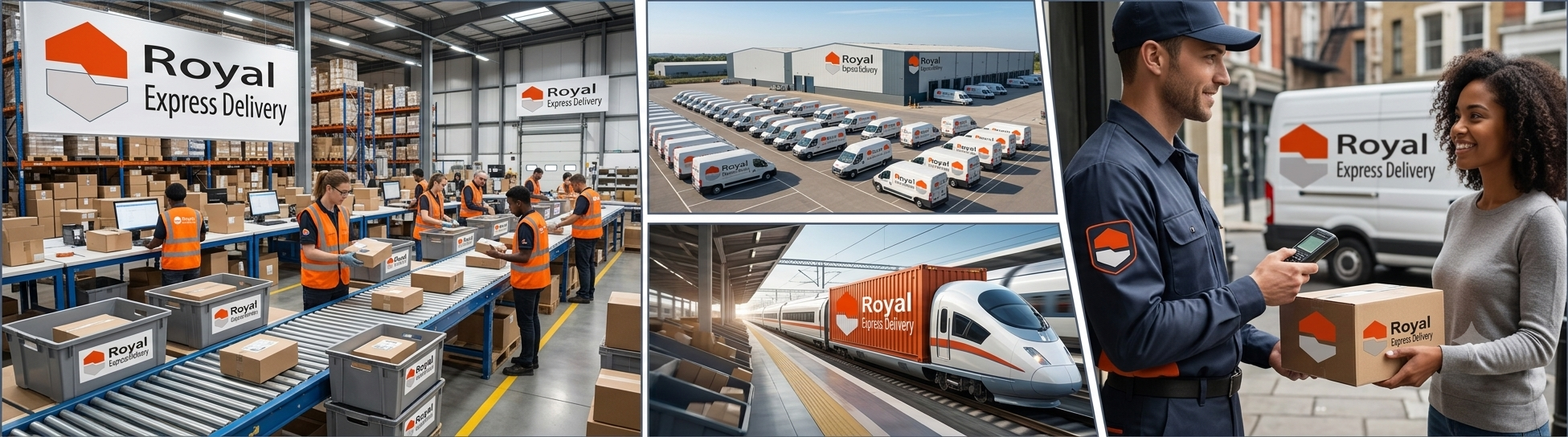
Royal Express Delivery: Leading Global Supply Chain and Freight Tracking Architecture
The international trade arena faces unprecedented structural changes. According to the 2026 Agility Emerging Markets Index, more than 86% of global logistics executives view macroeconomic volatility, fluctuating cross-border trade policies, and geopolitical fragmentation as the persistent baseline operational environment. From structural carrier consolidations in ocean freight to localized capacity constraints caused by the Federal Motor Carrier Safety Administration (FMCSA) non-domiciled Commercial Driver’s License (CDL) verification rollouts, enterprises require an agile partner.
As an elite international logistics firm, Royal Express Delivery offers a resilient multi-modal transport infrastructure. Operating via our digital ecosystem royal-expressdelivery.com, we provide full cargo transparency, custom brokers compliance, and high-velocity freight handling across domestic and international trade corridors.
Real-Time Consignment Telemetry & Package Tracking
In modern commerce, visibility directly influences supply chain value. Royal Express Delivery uses advanced data integration to provide instant tracking status updates from any cargo node worldwide. Whether monitoring high-value electronic components moving through Southeast Asia or a last-mile residential delivery, our tracking database gives you precise transit milestones.
1.Locate Your Tracking Identification Code:Identify Shipping Bill.
Locate the 12-digit custom alphanumeric waybill or consignment identifier printed clearly on your cargo invoice, receipt, or electronic booking ledger.
2.Access the Centralized Tracking Node:Secure Portal Entry.
Navigate directly to our optimized Tracking utility to establish a secure connection with our cloud database.
3.Input the Courier Identifier:Database Execution.
Enter your specific tracking number into the tracking box without spaces or special characters, then select the “Execute Query” button.
4.Analyze Cargo Status and Delivery Signatures:Milestone Extraction.
Review your real-time tracking dashboard, which displays customs clearance documentation, port arrivals, warehouse sorting timestamps, and electronic proof-of-delivery signatures.
2026 International Business, Politics, and Logistics Report
Global shipping routes are adapting rapidly to geopolitical shifts. In Europe, freight volumes are moving steadily toward Eastern European corridors, with Romania emerging as a key gateway to the European Union market. Concurrently, ongoing adjustments in maritime routing around major bottlenecks like the Red Sea, the Strait of Hormuz, and the Panama Canal have made air freight a crucial alternative for time-sensitive supply chains.
The international logistics market has shifted from simple freight forwarding to specialized compliance services. Following the structural removal of de minimis duty-free exemptions for direct-to-consumer international parcels entering North America, companies are establishing regional fulfillment centers to manage changing tariff structures. Royal Express Delivery addresses these market challenges by using predictive AI networks to anticipate port congestion, optimize warehouse placement, and protect clients from sudden spot-market rate changes.
                    ┌──────────────────────────────────────────────┐
                    │          Royal Express Delivery              │
                    │         Global Control Core 2026             │
                    └──────────────────────┬───────────────────────┘
                                           │
                 ┌─────────────────────────┼─────────────────────────┐
                 ▼                         ▼                         ▼
     ┌───────────────────────┐ ┌───────────────────────┐ ┌───────────────────────┐
     │  Air Freight Routing  │ │ Maritime Port Systems │ │ Overland Distribution │
     │ High-Value Next-Gen AI│ │ Multi-Alliance Access │ │ Last-Mile Fleet Nodes │
     └───────────────────────┘ └───────────────────────┘ └───────────────────────┘
Global Hub Network & Territorial Infrastructure
Our international supply chain spans major manufacturing sectors, trade zones, and metropolitan centers across multiple continents.
I. United States of America (All 50 States & Primary Hubs)
- Alabama: Processing regional industrial freight across distribution nodes in Birmingham, Montgomery, Mobile, Huntsville, and Tuscaloosa.
- Alaska: Managing specialized sub-zero line-haul connections and cargo air networks through Anchorage, Juneau, Fairbanks, Sitka, and Ketchikan.
- Arizona: Running Southwest regional shipping routes through Phoenix, Tucson, Mesa, Scottsdale, Tempe, and Flagstaff.
- Arkansas: Coordinating central logistics and final-mile transport via Little Rock, Fort Smith, Fayetteville, Springdale, and Jonesboro.
- California: Operating major Pacific gateways and intermodal ocean terminals across Los Angeles, San Francisco, San Diego, San Jose, Sacramento, Oakland, and Fresno.
- Colorado: Managing intermountain freight hubs and cross-docking infrastructure in Denver, Colorado Springs, Aurora, Fort Collins, Boulder, and Pueblo.
- Connecticut: Handling industrial corridor fulfillment through Bridgeport, New Haven, Hartford, Stamford, and Waterbury.
- Delaware: Providing mid-Atlantic sorting and corporate shipping services through Wilmington, Dover, Newark, Middletown, and Smyrna.
- Florida: Managing high-capacity maritime links to the Americas from Jacksonville, Miami, Tampa, Orlando, St. Petersburg, Tallahassee, and Fort Lauderdale.
- Georgia: Operating Southeast air-freight sorting centers and rail terminals via Atlanta, Augusta, Columbus, Savannah, Athens, and Macon.
- Hawaii: Coordinating trans-Pacific shipping routes through port facilities in Honolulu, Hilo, Kailua, Kapolei, and Kahului.
- Idaho: Handling agricultural and industrial freight lines through hubs in Boise, Meridian, Nampa, Idaho Falls, and Pocatello.
- Illinois: Managing major midwestern intermodal rail hubs and inland ports via Chicago, Aurora, Rockford, Joliet, Naperville, and Springfield.
- Indiana: Running central interstate freight lines through Indianapolis, Fort Wayne, Evansville, South Bend, Carmel, and Bloomington.
- Iowa: Processing agricultural technology manufacturing freight across Des Moines, Cedar Rapids, Davenport, Sioux City, and Iowa City.
- Kansas: Coordinating aviation manufacturing logistics through Wichita, Overland Park, Kansas City, Topeka, and Olathe.
- Kentucky: Running dedicated express sorting systems via Louisville, Lexington, Bowling Green, Owensboro, and Frankfort.
- Louisiana: Processing deepwater maritime commerce through port networks in New Orleans, Baton Rouge, Shreveport, Lafayette, and Lake Charles.
- Maine: Managing northeast cross-border freight routes via Portland, Lewiston, Bangor, South Portland, and Augusta.
- Maryland: Operating mid-Atlantic port facilities and terminal networks through Baltimore, Frederick, Rockville, Gaithersburg, and Annapolis.
- Massachusetts: Running industrial supply lines across Boston, Worcester, Springfield, Cambridge, Lowell, and New Bedford.
- Michigan: Managing automotive supply chains and manufacturing corridors across Detroit, Grand Rapids, Warren, Sterling Heights, Lansing, and Ann Arbor.
- Minnesota: Directing northern-tier distribution channels via Minneapolis, St. Paul, Rochester, Duluth, and Bloomington.
- Mississippi: Running Gulf Coast transport corridors through Jackson, Gulfport, Southaven, Biloxi, and可靠Hattiesburg.
- Missouri: Operating central cross-docking facilities via Kansas City, St. Louis, Springfield, Columbia, Independence, and Jefferson City.
- Montana: Managing northern border logistics routes across Billings, Missoula, Great Falls, Bozeman, and Helena.
- Nebraska: Processing midwest agricultural and consumer freight through Omaha, Lincoln, Bellevue, Grand Island, and Kearney.
- Nevada: Operating southwest logistics centers via Las Vegas, Henderson, Reno, North Las Vegas, Sparks, and Carson City.
- New Hampshire: Managing New England distribution corridors through Manchester, Nashua, Concord, Dover, and Rochester.
- New Jersey: Running high-density northeast sorting hubs via Newark, Jersey City, Paterson, Elizabeth, Edison, and Trenton.
- New Mexico: Operating southwest border trade corridors through Albuquerque, Las Cruces, Rio Rancho, Santa Fe, and Roswell.
- New York: Managing global commercial entry points across New York City, Buffalo, Rochester, Yonkers, Syracuse, and Albany.
- North Carolina: Directing southeast banking and manufacturing logistics via Charlotte, Raleigh, Greensboro, Durham, Winston-Salem, and Wilmington.
- North Dakota: Running upper-midwest energy sector freight routes through Fargo, Bismarck, Grand Forks, Minot, and West Fargo.
- Ohio: Managing manufacturing and distribution infrastructure across Columbus, Cleveland, Cincinnati, Toledo, Akron, and Dayton.
- Oklahoma: Operating central line-haul routes via Oklahoma City, Tulsa, Norman, Broken Arrow, and Lawton.
- Oregon: Running Pacific Northwest trade lines through Portland, Salem, Eugene, Gresham, Hillsboro, and Bend.
- Pennsylvania: Operating mid-Atlantic multi-modal distribution centers via Philadelphia, Pittsburgh, Allentown, Erie, Reading, and Harrisburg.
- Rhode Island: Handling coastal shipping and logistics through Providence, Warwick, Cranston, Pawtucket, and Newport.
- South Carolina: Managing southern maritime imports through Charleston, Columbia, North Charleston, Greenville, and Myrtle Beach.
- South Dakota: Running regional agricultural logistics channels via Sioux Falls, Rapid City, Aberdeen, Brookings, and Pierre.
- Tennessee: Directing central express freight sorting networks through Nashville, Memphis, Knoxville, Chattanooga, and Clarksville.
- Texas: Operating major international trade gateways and customs checkpoints across Houston, San Antonio, Dallas, Austin, Fort Worth, El Paso, Arlington, and McAllen.
- Utah: Running intermountain distribution lines through Salt Lake City, West Valley City, Provo, West Jordan, Orem, and Ogden.
- Vermont: Handling northeast border logistics through Burlington, South Burlington, Rutland, Barre, and Montpelier.
- Virginia: Managing mid-Atlantic maritime terminals and defense logistics networks via Virginia Beach, Norfolk, Chesapeake, Richmond, Newport News, and Alexandria.
- Washington: Directing Pacific Northwest maritime gateways through Seattle, Spokane, Tacoma, Vancouver, Bellevue, and Olympia.
- West Virginia: Managing Appalachian freight corridors via columns in Charleston, Huntington, Morgantown, Parkersburg, and Wheeling.
- Wisconsin: Operating upper-midwest manufacturing line-haul routes through Milwaukee, Madison, Green Green Bay, Kenosha, Racine, and Appleton.
- Wyoming: Managing mountain-region transport lines through Cheyenne, Casper, Laramie, Gillette, and Rock Springs.
United States Territories & Insular Areas
- Puerto Rico (Commonwealth): Operating Caribbean logistics networks through San Juan, Bayamón, Carolina, Ponce, Caguas, and Mayagüez.
- Guam: Managing Western Pacific transit hubs via Dededo, Yigo, Tamuning, Mangilao, and Hagåtña.
- U.S. Virgin Islands: Coordinating island freight networks through Charlotte Amalie (St. Thomas), Christiansted (St. Croix), and Cruz Bay (St. John).
- American Samoa: Handling South Pacific ocean cargo connections through Pago Pago, Tafuna, Leone, and Faleniu.
- Northern Mariana Islands: Running Micronesian distribution loops via Saipan (Garapan), Tinian, and Rota.
Canada & Mexico
- Canada: Processing cross-border trade across major provincial corridors including Ontario (Toronto, Ottawa), Quebec (Montreal, Quebec City), British Columbia (Vancouver, Victoria), and Alberta (Calgary, Edmonton).
- Mexico: Coordinating nearshoring manufacturing logistics via Ciudad de México (Mexico City), Jalisco (Guadalajara), Nuevo León (Monterrey), and Quintana Roo (Cancún).
II. UAE & The Gulf (GCC) Region
The Gulf Cooperation Council (GCC) area functions as a central trade crossroads. Our logistics infrastructure links major manufacturing and energy hubs throughout the region.
- United Arab Emirates (UAE): Directing supply chains across all seven emirates: Abu Dhabi, Dubai, Sharjah, Ajman, Umm Al Quwain, Ras Al Khaimah, and Fujairah. Primary tracking nodes are centered in Dubai City, Abu Dhabi City, Al Ain, Sharjah City, Ajman City, Ras Al Khaimah City, Fujairah City, Jebel Ali,豪Khor Fakkan, and Ruwais.
- Saudi Arabia: Managing key provincial routes across Riyadh, Makkah, Eastern Province, Madinah, Asir, and Al-Qassim, utilizing primary distribution hubs in Riyadh, Jeddah, Dammam, Mecca, Medina, Al Khobar, Dhahran, Jubail, and Yanbu.
- Kuwait: Connecting governance zones including Al Asimah, Hawally, Farwaniya, Ahmadi, Jahra, and Mubarak Al-Kabeer through freight terminals in Kuwait City, Hawally, Salmiya, Al Jahra, Fahaheel, and Shuwaikh.
- Qatar: Running municipal freight transport throughout Doha, Al Rayyan, Al Wakrah, Al Khor, Al Daayen, and Umm Salal via logistics centers in Doha, Al Wakrah, Al Khor, Lusail City, Mesaieed, and Ras Laffan.
- Oman: Operating across regional directorates including Muscat, Dhofar, Al Batinah, Ad Dakhiliyah, Musandam, and Ash Sharqiyah, using primary ports in Muscat, Salalah, Sohar, Nizwa, Sur, Khasab, and Duqm.
- Bahrain: Directing national distribution networks through the Capital, Muharraq, Northern, and Southern governorates, anchored by facilities in Manama, Riffa, Muharraq, Hamad Town, Hidd, and Sitra.
III. Europe & Northern Eurasia
Our European division links industrial manufacturing zones with major maritime and overland corridors.
- Romania: Managing key European transit nodes through Bucharest, Cluj County (Cluj-Napoca, Turda, Dej), Timiș County (Timișoara, Lugoj), Constanța County (Constanța, Mangalia, Năvodari), Iași County (Iași, Pașcani), Brașov County (Brașov, Făgăraș, Săcele), and Bihor County (Oradea, Beiuș).
- Russian Federation: Coordinating transport routes across major economic districts including Moscow, Voronezh, Yaroslavl, St. Petersburg, Kaliningrad, Murmansk, Novosibirsk, Omsk, Krasnoyarsk, Irkutsk, Kazan, Nizhny Novgorod, Samara, Ufa, Perm, Yekaterinburg, Chelyabinsk, Tyumen, Rostov-on-Don, Krasnodar, and Volgograd.
- Ukraine: Operating regional logistics connections across Kyiv, Bila Tserkva, Boryspil, Kharkiv, Izium, Lozova, Lviv, Drohobych, Stryi, Odesa, Chornomorsk, Izmail, Dnipro, Kryvyi Rih, Kamianske, Zaporizhzhia, Melitopol, Ivano-Frankivsk, and Kolomyia.
- Western Europe Core: Connecting key industrial markets across the United Kingdom (London, Manchester, Birmingham, Glasgow, Edinburgh, Cardiff, Belfast), Germany (Munich, Berlin, Cologne, Düsseldorf, Frankfurt), France (Paris, Marseille, Nice, Lyon), Italy (Rome, Milan, Venice, Naples), and Spain (Madrid, Barcelona, Seville, Valencia).
IV. Asia & Southeast Asia
Our Asian network covers major manufacturing zones, deepwater ports, and financial hubs.
- Singapore: Operating an integrated urban distribution network across the Central Region (Downtown Core, Bukit Merah, Queenstown, Toa Payoh), East Region (Bedok, Tampines, Pasir Ris, Changi Logistics Hub), West Region (Jurong East, Jurong West, Clementi, Tuas Industrial Hub), North Region (Woodlands, Yishun, Sembawang), and North-East Region (Hougang, Sengkang, Punggol, Serangoon).
- Thailand: Directing manufacturing supply lines through Bangkok, Nonthaburi, Samut Prakan, Chiang Mai, Mae Rim, Chonburi, Pattaya City, Laem Chabang Deep Seaport, Phuket City, Patong, Thalang, Nakhon Ratchasima, Pak Chong, Hat Yai, and Songkhla City.
- Uzbekistan: Managing Central Asian trade lines across Tashkent, Angren, Chirchiq, Bekabad, Samarkand, Kattakurgan, Bukhara, Kagán, Fergana, Kokand, Margilan, Andijan, Asaka, Namangan, Chust, Navoiy, and Zarafshan.
V. South America
Our South American framework connects major maritime gateways with agricultural and industrial production areas.
- Brazil: Operating high-capacity line-haul networks across São Paulo, Rio de Janeiro, Minas Gerais, Bahia, and Rio Grande do Sul, with primary sorting centers in São Paulo, Rio de Janeiro, Belo Horizonte, Salvador, Porto Alegre, Brasília, and the Port of Santos.
- Argentina: Managing regional trade lanes across Buenos Aires, Córdoba, Santa Fe, and Mendoza, with hubs in Buenos Aires, Córdoba, Rosario, Mendoza, and Mar del Plata.
- Colombia: Directing northern Andean supply chains through Cundinamarca, Antioquia, Valle del Cauca, Atlántico, and Bolívar, using distribution centers in Bogotá, Medellín, Cali, Barranquilla, and Cartagena.
- Peru: Running Pacific maritime links through Lima, Arequipa, La Libertad, Cusco, and Callao, anchored by our primary infrastructure in Lima, Arequipa, Trujillo, Cusco, and the Port of Callao.
- Chile: Operating long-haul transport corridors across the Santiago Metropolitan, Valparaíso, Biobío, and Antofagasta regions, utilizing distribution nodes in Santiago, Valparaíso, Concepción, Antofagasta, and San Antonio.
Strategic Navigation & Regulatory Links
To set up a commercial account, review custom compliance updates, or track an incoming shipment, use our dedicated portal links:
- Home — Global Logistics Portal Overview
- About — Corporate Capabilities & Fleet Infrastructure
- Services — Air, Ocean, and Intermodal Freight Options
- Tracking — Real-Time Consignment Telemetry
- FAQ — Customs, Tariffs, and Regulatory Guidelines
- Contact — International Customer Service & Commercial Sales


Leave a comment